




Comprehensive Discovery Assessment
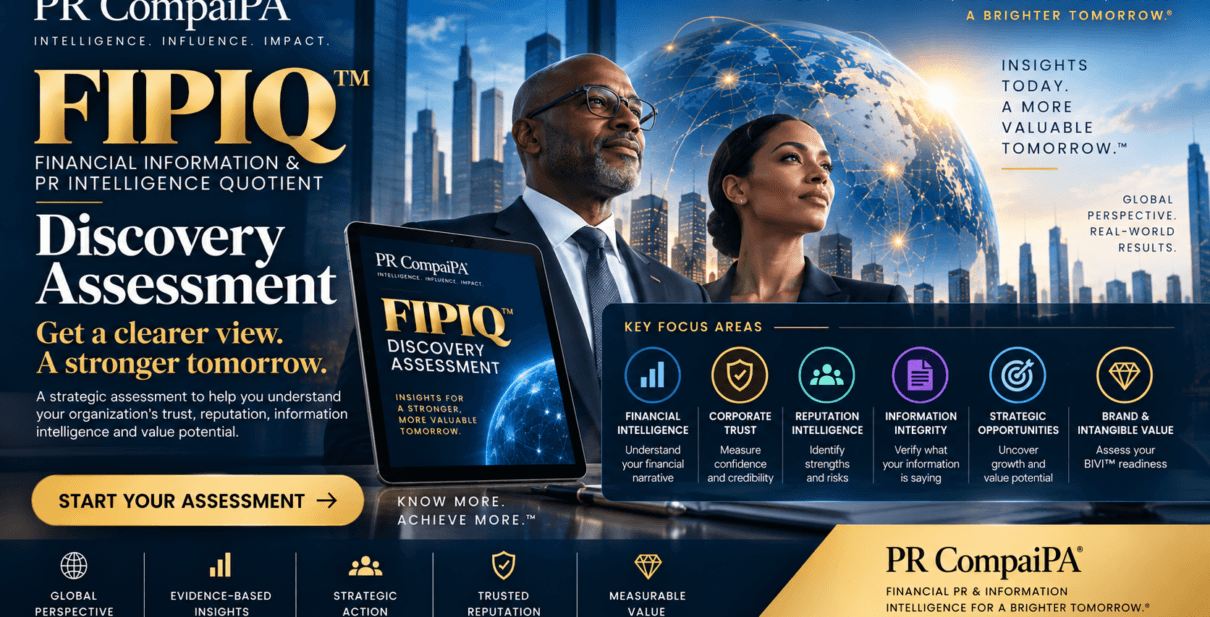
FIPIQ™
Financial Information & PR Intelligence Quotient
Comprehensive Discovery Assessment
FIPIQ™ is an Enterprise AI Financial PR & Intelligence Operating System and one of the core intelligence techniques of PR CompaiPA.
Transform Information into Intelligence. Intelligence into Strategic Action. Trust into Value.™
1. PURPOSE OF THE ASSESSMENT
The FIPIQ™ Comprehensive Discovery Assessment is designed to help organizations determine how effectively they manage, verify, interpret, communicate, and create value from their financial and corporate information.
It identifies gaps between:
Information → Evidence → Intelligence → Strategy → Communication → Execution → Trust → Value
The assessment is designed for:
- CEOs and Managing Directors
- CFOs and Finance Directors
- Chief Communications Officers
- Corporate Affairs Directors
- Investor Relations Directors
- Chief Risk Officers
- Strategy Directors
- Company Secretaries
- Board Directors
- Public Affairs and Government Relations executives
- Marketing and Reputation leaders
- Investment and financial institutions
- Listed and privately held companies
- Multinationals and large enterprises
- Government-owned enterprises and institutions
The central FIPIQ™ question:
Does your organization merely have financial and corporate information—or does it have the intelligence infrastructure to know what the information means, what stakeholders believe, what risks are emerging, what should be communicated, and what intangible value is being created or destroyed?
2. THE FIPIQ™ INTELLIGENCE ARCHITECTURE
FIPIQ™ connects four strategic intelligence layers:
| Layer | Function | Core Question |
|---|---|---|
| VERIQ™ | Measure & Verify | Can we prove it? |
| FINIQ™ | Interpret & Advise | What does the evidence mean? |
| PR CompaiPA | Strategize • Communicate • Execute | What should we do? |
| VALORA™ | Value • Model • Monetize | What is it worth? |
Proprietary intelligence outputs
Corporate Trust Score™
How much confidence does the available evidence justify?
BIVI™ — Brand & Intangible Value Intelligence Index
What strategic brand, reputation, trust, relationship, and intangible capital does the organization possess, and what is its defensible economic value?
3. EXECUTIVE QUICK DISCOVERY
Complete this section in approximately 5 minutes.
A. Organization Profile
Organization: ______________________________
Website: ______________________________
Industry/Sector: ______________________________
Country/Region: ______________________________
Annual Revenue Range:
☐ Under $10M
☐ $10M–$50M
☐ $50M–$250M
☐ $250M–$1B
☐ $1B–$5B
☐ Above $5B
☐ Prefer not to disclose
Organization Type:
☐ Publicly listed
☐ Private company
☐ Family-owned
☐ Multinational
☐ Government-owned
☐ Financial institution
☐ Investment organization
☐ Non-profit/institution
☐ Other: _____________
4. EXECUTIVE PRIORITY
What is the primary reason your organization is exploring FIPIQ™?
Select up to three.
☐ Improve financial communication
☐ Strengthen investor confidence
☐ Improve corporate reputation
☐ Increase stakeholder trust
☐ Improve information quality
☐ Detect reputational risk earlier
☐ Prepare for a crisis
☐ Improve financial PR
☐ Improve investor relations
☐ Understand stakeholder perceptions
☐ Improve executive positioning
☐ Strengthen corporate communications
☐ Understand the economic value of brand and reputation
☐ Improve strategic decision-making
☐ Support fundraising or capital-market activity
☐ Prepare for expansion or transformation
☐ Improve board-level intelligence
☐ Other: __________________________
5. THE FIVE-MINUTE FIPIQ™ SNAPSHOT
Rate each statement:
1 = Strongly Disagree
2 = Disagree
3 = Partially Agree
4 = Agree
5 = Strongly Agree
| # | Assessment Statement | Score |
|---|---|---|
| 1 | We know which financial and corporate information is material to our stakeholders. | 1 2 3 4 5 |
| 2 | We can verify the evidence behind important corporate claims. | 1 2 3 4 5 |
| 3 | Our executives receive timely intelligence rather than disconnected information. | 1 2 3 4 5 |
| 4 | We understand how investors and stakeholders interpret our financial performance. | 1 2 3 4 5 |
| 5 | Our financial and corporate communications are evidence-led. | 1 2 3 4 5 |
| 6 | We can identify reputation and trust risks before they become crises. | 1 2 3 4 5 |
| 7 | We have a structured process for challenging assumptions and contradictory evidence. | 1 2 3 4 5 |
| 8 | Our corporate narrative is aligned with financial and operational reality. | 1 2 3 4 5 |
| 9 | Senior management can connect reputation and stakeholder confidence to business outcomes. | 1 2 3 4 5 |
| 10 | We have a credible methodology for measuring the economic value of intangible assets. | 1 2 3 4 5 |
Quick FIPIQ™ Index
Total Score: ______ / 50
The score is a diagnostic indicator, not an audit, certification,n or valuation conclusion. A comprehensive assessment requires evidence review.
6. SECTION ONE — INFORMATION INTELLIGENCE
Objective
Determine whether the organization has the information infrastructure required for reliable financial and corporate intelligence.
Questions
- What are your organization’s most important sources of financial information?
- What are your most important sources of corporate and stakeholder information?
- Who owns financial information internally?
- Who owns corporate information?
- Are financial, operational, communications, investor, and reputation data connected?
☐ Fully integrated
☐ Partially integrated
☐ Mostly siloed
☐ Completely siloed
☐ Unknown
- How quickly can executives obtain reliable information about a developing corporate issue?
☐ Minutes
☐ Hours
☐ One day
☐ Several days
☐ More than a week
☐ Unknown
- What information is currently difficult to access?
- What information do executives most frequently request that is not readily available?
- What information is currently duplicated across departments?
- What information gap creates the greatest strategic risk?
FIPIQ™ diagnostic focus
Information Availability → Information Quality → Information Integration → Decision Readiness
7. SECTION TWO — VERIQ™: EVIDENCE & VERIFICATION
Core question:
Can we prove it?
Assess the organization’s ability to distinguish evidence from assertion.
Questions
- Does the organization maintain a formal evidence or source-verification process?
- How are major corporate claims verified?
- Are claims linked to primary evidence?
- Are sources dated and traceable?
- Are important claims independently corroborated?
- How does the organization deal with contradictory evidence?
- Can management identify outdated or superseded information?
- Are material assumptions documented?
- Can executives distinguish between:
☐ Verified information
☐ Corroborated information
☐ Observed information
☐ Inferred information
☐ Modelled information
☐ Hypothesized information
☐ Unknown information
- Does the organization have a process for challenging a conclusion before it becomes a public communication?
Evidence Readiness
☐ Advanced
☐ Established
☐ Developing
☐ Weak
☐ Unknown
Key evidence challenge
What is the most important corporate claim that your organization would find difficult to prove independently today?
8. SECTION THREE — FINIQ™: FINANCIAL INTELLIGENCE
Core question:
What does the financial evidence mean?
Financial intelligence areas
Assess your current capability.
| Area | Strong | Moderate | Weak | Unknown |
|---|---|---|---|---|
| Revenue intelligence | ☐ | ☐ | ☐ | ☐ |
| Profitability intelligence | ☐ | ☐ | ☐ | ☐ |
| Cash-flow intelligence | ☐ | ☐ | ☐ | ☐ |
| Liquidity intelligence | ☐ | ☐ | ☐ | ☐ |
| Debt and leverage intelligence | ☐ | ☐ | ☐ | ☐ |
| Capital allocation intelligence | ☐ | ☐ | ☐ | ☐ |
| Investor intelligence | ☐ | ☐ | ☐ | ☐ |
| Market intelligence | ☐ | ☐ | ☐ | ☐ |
| Economic intelligence | ☐ | ☐ | ☐ | ☐ |
| Regulatory intelligence | ☐ | ☐ | ☐ | ☐ |
Discovery Questions
- What financial indicator is currently most important to management?
- Which financial indicator is most misunderstood by stakeholders?
- What financial issue creates the greatest investor concern?
- What financial issue creates the greatest reputational risk?
- What economic or regulatory development could materially affect your organization?
- How effectively does management connect financial results with stakeholder expectations?
- Do executives receive forward-looking financial intelligence?
☐ Yes
☐ Partially
☐ No
9. SECTION FOUR — CORPORATE TRUST INTELLIGENCE
Core question:
How much confidence does the evidence justify?
Assess the organization’s perceived and evidence-supported strength in:
Credibility
- Accuracy of information
- Reliability of corporate claims
- Disclosure consistency
- Leadership credibility
Competence
- Operational capability
- Financial capability
- Strategic execution
- Management effectiveness
Transparency
- Quality of disclosure
- Accessibility of information
- Timeliness
- Explanation of material developments
Integrity
- Consistency between words and actions
- Governance
- Ethical conduct
- Accountability
Responsibility
- Stakeholder responsibility
- Regulatory responsibility
- Social responsibility
- Crisis responsibility
Discovery Questions
- What is your organization’s strongest trust attribute?
- What is its weakest?
- What evidence supports your answer?
- Where is there a gap between corporate intention and stakeholder perception?
- Have you experienced a measurable decline in stakeholder confidence?
- What event could most seriously damage trust?
10. SECTION FIVE — REPUTATION INTELLIGENCE
Separate reputation into three dimensions:
Reputation Performance
What the organization actually does.
Reputation Perception
What stakeholders believe about the organization.
Reputation Exposure
Where reputation could be damaged.
Discovery Questions
- Who are your five most important stakeholder groups?
- What does each stakeholder group expect from you?
- What does each group currently believe about your organization?
- Where do stakeholder expectations differ from corporate performance?
- Which stakeholder group represents the greatest reputation risk?
- Which stakeholder group represents the greatest opportunity?
- How frequently is reputation measured?
☐ Continuously
☐ Monthly
☐ Quarterly
☐ Annually
☐ Ad hoc
☐ Not measured
- What reputation issue keeps management awake at night?
11. SECTION SIX — INVESTOR CONFIDENCE INTELLIGENCE
Core question:
Does the organization’s communication justify investor confidence?
Assessment areas
Rate each:
| Dimension | 1 | 2 | 3 | 4 | 5 |
|---|---|---|---|---|---|
| Disclosure quality | ☐ | ☐ | ☐ | ☐ | ☐ |
| Strategic clarity | ☐ | ☐ | ☐ | ☐ | ☐ |
| Management credibility | ☐ | ☐ | ☐ | ☐ | ☐ |
| Investor communication | ☐ | ☐ | ☐ | ☐ | ☐ |
| Guidance credibility | ☐ | ☐ | ☐ | ☐ | ☐ |
| Transparency | ☐ | ☐ | ☐ | ☐ | ☐ |
| Investor engagement | ☐ | ☐ | ☐ | ☐ | ☐ |
| Financial narrative | ☐ | ☐ | ☐ | ☐ | ☐ |
Discovery Questions
- What do investors most frequently ask?
- What financial story does management want investors to understand?
- What financial story do investors actually appear to hear?
- Where is there a communication gap?
- What information could materially improve investor understanding?
12. SECTION SEVEN — PR COMPAIPA STRATEGIC INTELLIGENCE
Core question:
What should we do?
Assess the organization’s ability to convert intelligence into strategic communication.
Capabilities
☐ Financial PR
☐ Investor Relations
☐ Corporate Communications
☐ Media Relations
☐ Executive Positioning
☐ Thought Leadership
☐ Stakeholder Engagement
☐ Government/Public Affairs
☐ Crisis Communications
☐ Reputation Management
☐ Reputation Recovery
☐ Strategic Corporate Advisory
Discovery Questions
- What is your most important corporate narrative?
- Is the narrative supported by independently verifiable evidence?
- Does the narrative connect financial performance to strategic meaning?
- Is communication consistent across CEO, CFO, IR, PR, and corporate channels?
- Which audience is currently hardest to communicate with?
- What important message is your organization struggling to communicate?
- What communication issue would you most like to solve in the next 90 days?
13. SECTION EIGHT — CRISIS & REPUTATION READINESS
Core question:
What happens when the information environment changes faster than the organization can respond?
Assessment
| Capability | Strong | Moderate | Weak | None |
|---|---|---|---|---|
| Crisis governance | ☐ | ☐ | ☐ | ☐ |
| Crisis team | ☐ | ☐ | ☐ | ☐ |
| Crisis scenarios | ☐ | ☐ | ☐ | ☐ |
| Escalation procedures | ☐ | ☐ | ☐ | ☐ |
| Stakeholder mapping | ☐ | ☐ | ☐ | ☐ |
| Executive preparedness | ☐ | ☐ | ☐ | ☐ |
| Media preparedness | ☐ | ☐ | ☐ | ☐ |
| Digital response | ☐ | ☐ | ☐ | ☐ |
| Crisis simulation | ☐ | ☐ | ☐ | ☐ |
| Recovery planning | ☐ | ☐ | ☐ | ☐ |
Critical Questions
- What is the most likely major crisis your organization could face?
- What is the most damaging plausible crisis?
- How quickly could management establish verified facts?
- Who has authority to approve public communication?
- How quickly could your organization produce an evidence-backed response?
14. SECTION NINE — INTANGIBLE VALUE & BIVI™ READINESS
Core question:
What is the organization’s intangible capital worth—and what evidence supports that conclusion?
Assess the following capital categories:
☐ Brand Capital
☐ Trust Capital
☐ Reputation Capital
☐ Relationship Capital
☐ Information Capital
☐ Leadership Capital
☐ Resilience Capital
☐ Strategic Future Capital
Discovery Questions
- Does your organization currently measure brand value?
- Does it measure trust?
- Does it measure reputation?
- Does it measure stakeholder relationship value?
- Does it quantify the economic effect of reputation?
- Does it measure the potential cost of lost trust?
- Can management connect brand or reputation to:
- Revenue?
- Customer retention?
- Pricing?
- Market access?
- Cost of capital?
- Investor confidence?
- Employee retention?
- Risk?
- Crisis recovery?
- What intangible asset do you believe is most valuable?
- What evidence supports that belief?
- What intangible asset is currently underutilized?
15. SECTION TEN — DATA, TECHNOLOGY & AI READINESS
FIPIQ™ Enterprise AI Readiness
- What financial systems does your organization use?
- What CRM/customer intelligence systems are available?
- What media monitoring systems are available?
- What social listening systems are available?
- What investor intelligence systems are available?
- What reputation monitoring systems are available?
- What AI tools are currently used?
- Are your data sources integrated?
- Can your organization trace an AI-generated insight back to its underlying evidence?
- What AI governance controls are currently in place?
AI Readiness
☐ Advanced
☐ Established
☐ Developing
☐ Early-stage
☐ Not yet implemented
16. SECTION ELEVEN — EXECUTIVE DECISION INTELLIGENCE
Identify the decisions FIPIQ™ could help improve.
Select all applicable:
☐ Capital allocation
☐ Investment decisions
☐ Financial communication
☐ Investor communication
☐ Corporate positioning
☐ Reputation strategy
☐ Crisis response
☐ Stakeholder engagement
☐ Executive positioning
☐ M&A communication
☐ Fundraising
☐ Market expansion
☐ Regulatory response
☐ Policy engagement
☐ Brand investment
☐ Corporate transformation
☐ Strategic planning
☐ Board reporting
☐ Other: ______________________
The most important decision:
What major decision would benefit most from better financial, corporate, stakeholder, or reputation intelligence?
17. SECTION TWELVE — THE 90-DAY BUSINESS PRIORITY
What would you most like FIPIQ™ to help your organization achieve within the next 90 days?
What would success look like?
What measurable outcome would demonstrate success?
What is preventing the organization from achieving it today?
18. SECTION THIRTEEN — THE FIPIQ™ PAIN-POINT MATRIX
Please identify your organization’s three greatest challenges.
Information
☐ Too much information
☐ Poor information quality
☐ Siloed information
☐ Slow information flow
Evidence
☐ Claims difficult to verify
☐ Conflicting information
☐ Weak source provenance
☐ Insufficient corroboration
Finance
☐ Financial complexity
☐ Investor expectations
☐ Financial risk
☐ Economic uncertainty
Reputation
☐ Stakeholder distrust
☐ Reputation exposure
☐ Negative perception
☐ Reputation measurement gap
Communications
☐ Weak corporate narrative
☐ Poor financial storytelling
☐ Investor communication gap
☐ Executive positioning
Crisis
☐ Crisis preparedness
☐ Response speed
☐ Governance
☐ Stakeholder coordination
Value
☐ Brand valuation
☐ Reputation valuation
☐ Trust valuation
☐ Intangible asset measurement
19. SECTION FOURTEEN — CURRENT PROVIDERS & INTERNAL CAPABILITY
Which capabilities currently exist internally?
☐ Finance Intelligence
☐ Investor Relations
☐ Corporate Communications
☐ Public Relations
☐ Reputation Management
☐ Risk Intelligence
☐ Market Intelligence
☐ Economic Intelligence
☐ Data Analytics
☐ AI Intelligence
☐ Crisis Management
☐ Valuation
External advisers currently used
☐ PR agency
☐ Financial PR agency
☐ Investor Relations adviser
☐ Management consultancy
☐ Financial adviser
☐ Valuation adviser
☐ Research/intelligence provider
☐ Technology provider
☐ None
What is missing?
20. SECTION FIFTEEN — FIPIQ™ PRIORITY SCORECARD
The assessment identifies potential gaps across ten intelligence dimensions.
| Dimension | Score / 5 |
|---|---|
| Information Intelligence | ___ |
| Evidence & Verification | ___ |
| Financial Intelligence | ___ |
| Corporate Trust | ___ |
| Reputation Intelligence | ___ |
| Investor Confidence | ___ |
| Strategic PR Intelligence | ___ |
| Crisis Readiness | ___ |
| Intangible Value Intelligence | ___ |
| AI & Data Readiness | ___ |
Preliminary FIPIQ™ Profile: ______ / 50
This profile is directional. A formal FIPIQ™ diagnostic should incorporate documentary evidence, interviews, source validation, and challenge testing.
21. FIPIQ™ DIAGNOSTIC MATURITY MODEL
LEVEL 1 — INFORMATION DEPENDENT
The organization possesses substantial information but has limited integration, verification, and strategic interpretation.
Primary opportunity: Build the evidence and intelligence foundation.
LEVEL 2 — EVIDENCE DEVELOPING
The organization has reliable information sources but inconsistent verification, corroboration, and challenge mechanisms.
Primary opportunity: Deploy VERIQ™.
LEVEL 3 — INTELLIGENCE ENABLED
The organization can interpret financial, corporate, stakeholder, and market information but intelligence may remain fragmented.
Primary opportunity: Deploy FINIQ™.
LEVEL 4 — STRATEGICALLY INTEGRATED
Evidence and intelligence influence corporate communication, stakeholder engagement, and executive decision-making.
Primary opportunity: Integrate PR CompaiPA strategic advisory.
LEVEL 5 — VALUE INTELLIGENT
The organization can connect trust, reputation, relationships, brand, and information capital to measurable economic outcomes.
Primary opportunity: Deploy VALORA™ + BIVI™.
22. FIPIQ™ CLIENT ACQUISITION ROUTING ENGINE
The assessment should automatically route prospects to the most relevant PR CompaiPA service.
| Discovery Finding | Recommended Entry Programme |
|---|---|
| Evidence weakness | VERIQ™ Evidence & Verification Diagnostic |
| Financial intelligence weakness | FINIQ™ Financial Intelligence Diagnostic |
| Investor confidence weakness | Investor Confidence Diagnostic |
| Corporate trust weakness | Corporate Trust Diagnostic™ |
| Reputation weakness | Reputation Intelligence Diagnostic |
| Crisis weakness | Crisis Readiness Diagnostic |
| Communication weakness | Financial PR Intelligence Programme |
| Executive positioning weakness | Executive Reputation & Positioning Advisory |
| AI/data weakness | FIPIQ™ Enterprise AI Intelligence Programme |
| Intangible value opportunity | BIVI™ Readiness Assessment |
| Multiple interconnected weaknesses | FIPIQ™ Enterprise Intelligence Diagnostic |
23. HIGH-INTENT BUYING SIGNALS
Flag a prospect as High Priority where the assessment reveals one or more of the following:
☐ Major corporate transformation underway
☐ Significant fundraising or capital-market activity
☐ Upcoming financial disclosure
☐ Investor confidence concerns
☐ Major reputation challenge
☐ Crisis or emerging crisis
☐ Regulatory or policy exposure
☐ M&A or strategic transaction
☐ Market expansion
☐ CEO/C-suite transition
☐ Major brand repositioning
☐ Need to quantify intangible value
☐ Board requesting stronger intelligence
☐ Existing PR/IR strategy not producing sufficient insight
☐ Executive leadership wants AI-enabled intelligence
24. EXECUTIVE DISCOVERY INTERVIEW
For qualified prospects, PR CompaiPA should conduct a 30–45 minute executive interview.
Five questions that unlock the opportunity
1. What is the most important financial or corporate issue your leadership team needs to understand better?
2. What information do you currently have difficulty verifying or interpreting?
3. Where do you believe there is a gap between what your organization knows and what its stakeholders believe?
4. What reputation, investor, or communication risk could materially affect the organization?
5. If FIPIQ™ solved one intelligence problem for you over the next 90 days, what would you want it to solve?
25. FIPIQ™ EVIDENCE REQUEST
For a comprehensive diagnostic, the client may provide relevant documents such as:
☐ Annual reports
☐ Financial statements
☐ Investor presentations
☐ Corporate strategy documents
☐ Sustainability reports
☐ Corporate communications
☐ Media coverage
☐ Investor communications
☐ Stakeholder research
☐ Reputation research
☐ Crisis plans
☐ Corporate governance documents
☐ Brand research
☐ Customer research
☐ Employee research
☐ Market research
☐ Previous valuation studies
☐ Relevant regulatory disclosures
☐ Other intelligence sources
Confidentiality requirements: __________________________
26. THE FIPIQ™ DIAGNOSTIC OUTPUT
Following discovery and evidence review, PR CompaiPA can produce a FIPIQ™ Corporate Intelligence Diagnostic Report containing:
Executive Intelligence Dashboard
- FIPIQ™ Profile
- Evidence Coverage
- Corporate Trust Score™
- Reputation Intelligence Profile
- Investor Confidence Profile
- Information Integrity Profile
- Crisis Readiness Profile
- BIVI™ Readiness
- Priority Intelligence Gaps
Evidence Intelligence
- Evidence Ledger
- Source Provenance
- Contradictory Evidence
- Evidence Gaps
- Confidence Levels
- Key Assumptions
- Challenge Findings
Strategic Intelligence
- Top 10 Intelligence Gaps
- Top 10 Reputation Risks
- Top 10 Stakeholder Issues
- Top Financial PR Opportunities
- Executive Communication Priorities
- Investor Communication Priorities
Value Intelligence
- Brand Capital Assessment
- Trust Capital Assessment
- Reputation Capital Assessment
- Relationship Capital Assessment
- Information Capital Assessment
- Resilience Capital Assessment
- Preliminary BIVI™ Readiness
27. THE FIPIQ™ EVIDENCE-TO-VALUE CHAIN
INFORMATION
↓
VERIQ™ — VERIFY
Can we prove it?
↓
CONFIDENCE
How reliable is the evidence?
↓
FINIQ™ — INTERPRET
What does it mean?
↓
INTELLIGENCE
What are the implications?
↓
PR COMPAIPA — STRATEGIZE
What should we do?
↓
COMMUNICATE
What should stakeholders understand?
↓
EXECUTE
What action should the organization take?
↓
VALORA™ — VALUE
What economic effect can be evidenced?
↓
BIVI™
What is the defensible value of the organization’s brand and intangible capital?
28. COMMERCIAL CONVERSION PATH
The assessment should not end with a score.
It should create a diagnostic-to-advisory pathway.
STAGE 1
FIPIQ™ Quick Discovery Assessment
↓
STAGE 2
FIPIQ™ Corporate Trust & Evidence Diagnostic
↓
STAGE 3
VERIQ™ Evidence & Verification
↓
STAGE 4
FINIQ™ Enterprise Financial Intelligence
↓
STAGE 5
PR CompaiPA Strategic Financial PR & Intelligence Advisory
↓
STAGE 6
VALORA™ Value Intelligence
↓
STAGE 7
BIVI™ Brand & Intangible Value Intelligence Programme
↓
STAGE 8
Continuous FIPIQ™ Enterprise Intelligence Retainer
29. CLIENT ACQUISITION CTA
Your Organization Already Has the Information.
The question is whether you are converting that information into intelligence.
Financial information without interpretation can create uncertainty.
Corporate claims without evidence can create credibility risk.
Reputation without measurement can become an unmanaged liability.
Communication without intelligence can become disconnected from stakeholder reality.
And intangible value that is not measured can remain invisible to management and investors.
FIPIQ™ changes the equation.
Verify the evidence.
Interpret the intelligence.
Strategize the response.
Communicate with confidence.
Measure trust.
Understand intangible value.
Discover Your FIPIQ™ Intelligence Profile.
Complete the FIPIQ™ Comprehensive Discovery Assessment and begin identifying where your organization can improve financial intelligence, evidence quality, corporate trust, investor confidence, reputation resilience, and intangible value.
PR CompaiPA
Financial PR • Economic Intelligence • Policy Advisory
FIPIQ™ — Enterprise AI Financial PR & Intelligence OS
Transform Financial & Corporate Information into Verified Intelligence, Strategic Action, Trusted Reputation and Measurable Value.™
CTA: START YOUR FIPIQ™ DISCOVERY ASSESSMENT
30. INTERNAL PR COMPAIPA QUALIFICATION FIELDS
For use by the PR CompaiPA business-development team.
Lead Source: ______________________
Date: ______________________
Account Owner: ______________________
Decision Maker: ______________________
Decision Maker Role: ______________________
Estimated Organization Size: ______________________
Strategic Priority: ______________________
Urgency:
☐ Immediate
☐ 30 days
☐ 90 days
☐ 6 months
☐ Exploratory
Budget Status:
☐ Approved
☐ Under consideration
☐ Budget not established
☐ Unknown
Existing Adviser: ______________________
Competitive Situation: ______________________
Trigger Event: ______________________
Primary Pain: ______________________
Desired Outcome: ______________________
Recommended FIPIQ™ Programme: ______________________
Next Action: ______________________
Next Meeting Date: ______________________
31. FINAL EXECUTIVE PROMISE
FIPIQ™ is not another dashboard.
It is an Enterprise AI Financial PR & Intelligence Operating System designed to connect evidence, financial intelligence, corporate communication, stakeholder confidence, reputation, and intangible value.
It helps answer the questions that matter most:
What do we know?
How do we know it?
Can we prove it?
What does it mean?
Who is affected?
What should we communicate?
What should we do?
What could go wrong?
What value are we creating?
What value are we protecting?
What is the evidence-supported economic significance of our intangible capital?
FIPIQ™ turns those questions into an integrated intelligence process.
VERIQ™ → FINIQ™ → PR CompaiPA → VALORA™ → BIVI™
From Information to Intelligence.
From Intelligence to Trust.
From Trust to Strategic Action.
From Strategic Action to Value.
FIPIQ™ — Intelligence for Financial PR. Intelligence for Corporate Decisions. Intelligence for Enterprise Value.™
Powered by PR CompaiPA.
FIPIQ™, VERIQ™, FINIQ™, VALORA™ and BIVI™ are working proprietary brand names and should undergo appropriate trademark and legal clearance before commercial launch. FIPIQ™ outputs are strategic intelligence and decision-support tools and should not be represented as an audit, legal opinion, accounting conclusion, or certified independent valuation.