



Economic Intelligence: Turning Economic Data into National Prosperity
How MacroCompaiPA AI™ Helps Governments, Investors, Institutions and Enterprises Transform Economic Data into Foresight, Policy Intelligence and Strategic Action
Economic Intelligence: Turning Economic Data into National Prosperity™
Every economy produces enormous amounts of data.
GDP. Inflation. Interest rates. Exchange rates. Public debt. Tax revenue. Employment. Trade. Foreign investment. Energy. Infrastructure. Consumer spending. Industrial production. Population. Government expenditure.
Yet one of the biggest challenges facing modern decision-makers is not the absence of economic data.
It is the inability to transform that data quickly enough into economic intelligence.
And that distinction matters.
Because data tells you what happened.
Economic intelligence helps you understand why it happened, what it could mean, what may happen next, which risks deserve attention, where opportunities may exist, and what strategic decisions should be examined.
This is where artificial intelligence is beginning to reshape the economic intelligence landscape.
The Economic Intelligence Gap
A government may have hundreds of economic reports.
A financial institution may have sophisticated financial models.
An investor may have country-risk databases.
A corporation may have market research.
A development organization may have extensive socioeconomic data.
But if these information sources remain disconnected, decision-makers can still operate with an incomplete picture.
One institution sees inflation.
Another sees currency pressure.
Another sees declining investment.
Another sees infrastructure constraints.
Another sees rising imports.
Another sees unemployment.
The strategic challenge is connecting these signals.
Economic intelligence is therefore not simply the collection of economic data. It is the disciplined transformation of economic information into insights that can support strategic decision-making.
That is the intelligence gap MacroCompaiPA AI™ is designed to address.
What Is Economic Intelligence?
Economic intelligence can be understood as the systematic process of collecting, connecting, analyzing, and interpreting economic information to support better strategic decisions.
It extends beyond traditional economic reporting.
Traditional analysis might ask:
What happened to GDP?
Economic intelligence asks:
Why did GDP change, what factors contributed to the change, what sectors are affected, what could happen under different conditions, and what strategic implications should decision-makers consider?
This creates a progression:
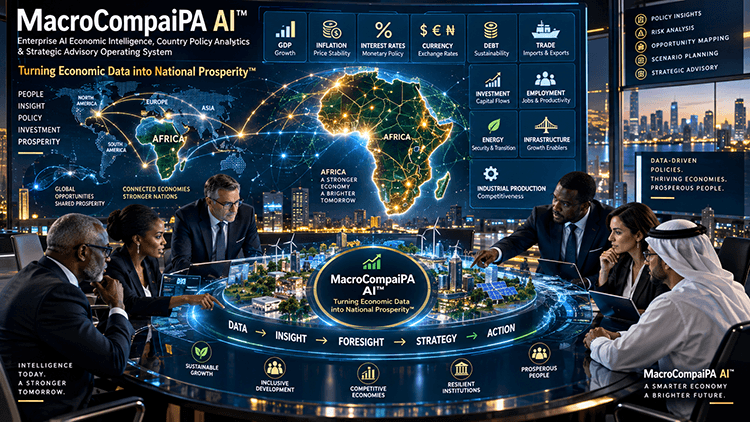
DATA → INFORMATION → INTELLIGENCE → FORESIGHT → STRATEGY → ACTION
The difference is significant.
Data is the raw material.
Information provides context.
Intelligence creates meaning.
Foresight explores possibilities.
Strategy determines how an organization may respond.
Action converts strategy into results.
Why Economic Intelligence Matters More Than Ever
Today’s economies operate within increasingly interconnected environments.
A geopolitical disruption can influence commodity prices.
A global interest-rate movement can affect capital flows.
Currency volatility can increase the cost of imported inputs.
Supply-chain disruptions can influence inflation.
Infrastructure constraints can reduce industrial productivity.
A regulatory change can alter investment decisions.
Technological disruption can transform entire industries.
This means economic decision-making can no longer rely exclusively on isolated indicators or periodic reports.
Decision-makers need to understand relationships between economic variables.
For example, rising inflation may appear manageable when viewed alone.
But what happens when rising inflation occurs alongside currency pressure, higher energy costs, declining investment, and increasing debt-service requirements?
The strategic interpretation changes.
This is the value of connected economic intelligence.
From Economic Data to Economic Foresight
One of the most important opportunities presented by artificial intelligence is the ability to process and connect large volumes of information.
AI can help examine relationships across economic statistics, policy announcements, market developments, trade information, investment activity, industry performance, and other relevant signals.
The objective is not to treat AI as an infallible economic predictor.
It is to use AI as a decision-support capability.
A sophisticated economic intelligence system can help decision-makers explore questions such as:
- What economic signals are changing?
- What may be driving those changes?
- Which sectors are most exposed?
- Which regions may be affected?
- What risks deserve further investigation?
- What opportunities are emerging?
- What could happen under alternative scenarios?
- Which indicators should decision-makers monitor?
- What policy or investment options could be evaluated?
This is the movement from economic analysis to economic foresight.
The Five Dimensions of Strategic Economic Intelligence
MacroCompaiPA AI™ can organize economic intelligence around five interconnected dimensions.
1. Economic Intelligence
Analyze macroeconomic and sectoral conditions, including growth, inflation, interest rates, currency, debt, employment, trade, investment, and productivity.
2. Policy Intelligence
Examine policies, regulations, fiscal measures, monetary conditions, and potential economic effects.
3. Risk Intelligence
Identify vulnerabilities, dependencies, emerging disruptions, and conditions that require closer monitoring.
4. Opportunity Intelligence
Identify potential investment, trade, infrastructure, industrial, technology, and market opportunities.
5. Strategic Intelligence
Bring the intelligence together to support scenario analysis, strategic planning, and executive decision-making.
Together, these dimensions create a more complete intelligence environment.
Why AI Changes the Economic Intelligence Equation
The economic environment generates information at a scale that can overwhelm conventional analytical processes.
Artificial intelligence can help organizations process information faster, identify relationships, organize complex evidence, and support scenario exploration.
But the most important concept is not AI replacing human expertise.
It is:
AI + Human Intelligence = Enhanced Decision Intelligence
Economists contribute economic theory and interpretation.
Policymakers contribute institutional knowledge.
Executives contribute strategic objectives.
Industry specialists contribute sector expertise.
AI contributes computational scale, information processing, and analytical support.
The combination can create a stronger environment for strategic decision-making.
From Policy Analysis to Policy Intelligence
Economic policy decisions rarely affect only one variable.
A tax policy may influence government revenue, investment and consumer behavior.
An interest-rate decision may affect inflation, borrowing costs and business investment.
Infrastructure investment may affect productivity, employment, logistics and regional development.
Industrial incentives may attract investment while creating fiscal or market considerations.
Therefore, effective policy intelligence should examine:
The problem.
The evidence.
The available options.
The potential first- and second-order effects.
The indicators that should be monitored after implementation.
This creates a continuous policy intelligence cycle rather than a one-time policy report.
Economic Risk Intelligence and Opportunity Intelligence
Economic intelligence should not focus exclusively on threats.
Every structural change can potentially produce both risk and opportunity.
A global manufacturing shift may threaten established industries while creating opportunities for countries capable of attracting new investment.
A new trade corridor may increase competitive pressure while creating logistics opportunities.
Energy-transition investment may disrupt traditional energy models while creating new industrial and technological markets.
Therefore, strategic economic intelligence should continuously ask two questions:
What could hurt us?
and
What could help us?
This balanced approach allows decision-makers to move beyond reactive crisis management toward strategic opportunity discovery.
MacroCompaiPA AI™: An Enterprise Economic Intelligence Operating System
MacroCompaiPA AI™ — Enterprise AI Economic Intelligence, Country Policy Analytics & Strategic Advisory Operating System — is designed around this intelligence challenge.
Its core promise is:
Turning Economic Data into National Prosperity™
The platform concept connects:
Economic Intelligence
↓
Country Intelligence
↓
Policy Intelligence
↓
Risk Intelligence
↓
Opportunity Intelligence
↓
Scenario Intelligence
↓
Strategic Advisory
This architecture can potentially support governments, ministries, financial institutions, investors, development organizations, corporations, research institutions, and strategic advisory organizations.
The objective is to shorten the distance between:
SIGNAL → INSIGHT → FORESIGHT → DECISION → ACTION
Who Needs Economic Intelligence?
Economic intelligence is relevant wherever major decisions depend upon economic conditions.
Potential users include:
- Governments and public institutions
- Ministries and government agencies
- Central banks and financial institutions
- Sovereign and institutional investors
- Development organizations
- Multinational corporations
- Corporate strategy teams
- Infrastructure investors
- Economic research institutions
- Consulting and advisory firms
- Investment and market-entry teams
For these organizations, the question is no longer simply whether they possess data.
The more important question is:
Can they convert their economic data into strategic intelligence before critical decisions have to be made?
The Strategic Economic Intelligence Advantage
The future of economic decision-making will not necessarily belong to institutions that collect the greatest amount of data.
It may increasingly belong to institutions that can connect, interpret, and operationalize economic intelligence effectively.
That means moving from:
Data collection → intelligence generation
Historical reporting → continuous analysis
Isolated indicators → connected economic signals
Reactive management → scenario-based planning
Risk awareness → risk and opportunity intelligence
Information overload → decision intelligence
This is the strategic opportunity behind MacroCompaiPA AI™.
The Question Every Strategic Decision-Maker Should Ask
Before the next major economic decision, investment decision, policy decision, or market-entry decision, ask:
What do we know?
What don’t we know?
What could change?
What risks are we underestimating?
What opportunities are we missing?
What scenarios should we examine?
What intelligence should we monitor continuously?
Those questions can expose the difference between having economic information and possessing economic intelligence.
And that difference can become strategically significant.
Turn Economic Data into National Prosperity eBook
Your Economic Intelligence Advantage Starts With One Conversation
You do not need more disconnected reports.
You need to understand whether your organization has the right economic intelligence architecture for the decisions ahead.
That is why MacroCompaiPA AI™ offers an Economic Intelligence Discovery Assessment.
The assessment is designed to help identify:
- your existing economic intelligence capabilities;
- critical intelligence gaps;
- priority economic and policy questions;
- emerging risks requiring deeper analysis;
- potential strategic opportunities;
- scenario-planning requirements;
- relevant intelligence and monitoring needs;
- areas where AI-supported economic intelligence could strengthen decision-making.
Don’t wait until the next economic disruption forces you to discover your intelligence gap.
The next strategic opportunity may already be hidden inside the economic data your organization possesses.
The next risk may already be generating signals.
The next investment opportunity may already be emerging.
The next policy challenge may already be visible.
The question is whether you can see it early enough.
Complete the MacroCompaiPA AI™ Discovery Assessment Questionnaire Today.
Begin the conversation about how your organization can transform economic data into intelligence, intelligence into foresight, and foresight into strategic action.
MACROCOMPAIPA AI™
Enterprise AI Economic Intelligence, Country Policy Analytics & Strategic Advisory Operating System