




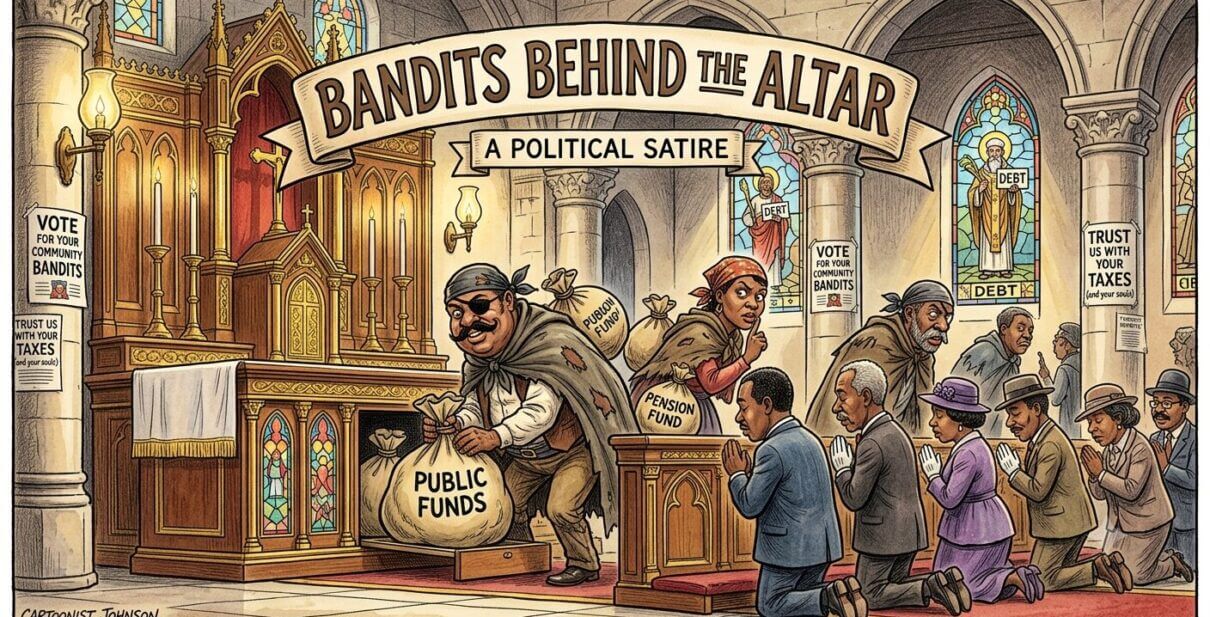
The Republic of Amandia recently emerged from a devastating economic collapse, a crisis so severe that it dismantled decades of political patronage and forced the nation to adopt painful, sweeping reforms. While inflation has finally stabilized and investors are returning to the country, the sudden loss of old-money influence has created a dangerous vacuum. Power rarely sits idle for long.
In the satirical world of Bandits Behind the Altar, this void is filled not by soldiers or CEOs, but by the Episcopal Conference of St. Aurelius, a group of high-ranking clerics who trade their spiritual robes for the dark suits of political brokers.
This narrative serves as a stark reminder of how easily moral authority can be weaponized to protect institutional privilege when democratic guards are lowered.
Readers will observe the calculated maneuvers of Cardinal Aurelius Valen, a strategist who views the pulpit as a platform for lobbying rather than liturgy. The story follows a “pastoral mission for national renewal” that functions as a sophisticated media campaign to reinstate a defeated presidential candidate. By examining the private meetings and backroom deals of these fictional bishops, the article explores the subtle ways that ambition can be cloaked in the language of righteousness.
This analysis unmasks the players behind the pulpit, explains how national crises pave the way for such “bandits behind the altar,” and provides a framework for spotting similar patterns of influence in modern political landscapes. It is a study of the universal temptation to use virtue as a shield for raw, unadulterated ambition.
“Satire provides the necessary distance to examine how the most sacred institutions can become entangled in the very secular pursuit of power.”
–
The transition from moral leadership to political activism is often invisible to the average citizen. Through the lens of this satire, the reader gains a clearer understanding of the fragile nature of democratic institutions. It becomes evident that when the pursuit of influence undermines democratic ideals, the cost is often the very integrity the institution claims to uphold. Understanding these dynamics is dead simple once the masks are removed.
Unmasking the ‘Pastoral Mission for National Renewal’
Institutional labels often serve as a protective layer, shielding internal maneuvers from the scrutiny of the public eye. In the case of the Episcopal Conference of St. Aurelius, the facade is a carefully curated image of piety and selfless service.
While their public sermons emphasize the virtues of sacrifice and integrity, the reality behind closed doors involves a sharp pivot toward pragmatic power-broking. This gap between the holy rhetoric and the gritty details of elite alliances suggests that the organization is less interested in spiritual guidance than in maintaining its own institutional privilege.
The architect of this strategy is Cardinal Aurelius Valen, a figure whose brilliance lies in his ability to treat influence as a commodity. He does not merely oversee a religious body; he manages a sophisticated operation that functions like a high-stakes political consultancy. Valen’s primary devotion is to the expansion of his reach, utilizing his position to broker deals that would be unthinkable for a typical clergyman. His leadership transforms the conference from a moral guide into a strategic powerhouse capable of shifting national policy through sheer willpower.
At the heart of this operation is the so-called “pastoral mission for national renewal.” On paper, it appears to be a call for healing and reconciliation. In practice, the mission is a multi-pronged campaign involving several aggressive tactics:
- Direct lobbying of government officials to influence legislative outcomes.
- Aggressive media manipulation to control the narrative in the press.
- Secretive backroom negotiations with ousted political elites.
- Public political theatre designed to pressure reform-minded leaders.
This systematic co-opting of religious language for political ends creates a dangerous precedent for any democracy. It raises the question of how easily public trust can be eroded when the lines between faith and ambition are intentionally blurred. This tension highlights the institutional vulnerabilities that enable such campaigns to flourish, particularly when a nation is already reeling from intense instability.
How Amandia’s Crisis Paved the Way for ‘Bandits’
Deciding whether to support radical economic restructuring or maintain the status quo defines the Republic of Amandia. The nation is currently emerging from its most brutal economic downturn in generations, a period marked by hyper-inflation and empty shelves. While recent data shows that inflation has fallen and international investors are finally returning to the country, the journey to full stability has started. The very reforms that eased these shortages also systematically stripped away the patronage systems that once fed the country’s elites.
of traditional patronage networks were disrupted by new transparency reforms
The dismantling of these old power structures created a vacuum that few expected. For decades, influential figures relied on state-sanctioned favoritism to maintain their standing. When the new order prioritized fiscal integrity over backroom deals, those who lost their “seat at the table/altar” grew desperate.
I have seen this pattern in many transitioning democracies; when the money stops flowing through traditional channels, the powerful seek new, more “righteous” avenues to reassert their dominance. It is not a matter of if they will push back, but how they will disguise the effort.
This environment of transition is exactly where political opportunism finds its footing. As public confidence begins a slow recovery, the friction between the reformers and the displaced elite intensifies. The losers of these economic shifts are not merely fading away; they are looking for a vessel to carry their grievances back into the halls of government.
This tension raises an uncomfortable question about who truly stands to gain when a nation’s moral guardians decide to step into the wreckage of a post-crisis economy. The shift from managing souls to managing political outcomes is often a response to this loss of material privilege.
The Players Behind the Altar and Their Real Agendas
Identify the primary architect of the current movement to understand how the pastoral mission operates as a political engine. The Episcopal Conference is not a monolith of shared spirituality, but rather a collection of high-stakes players whose individual ambitions often outweigh their collective vows. At the center of this web stands a charismatic strategist whose primary interest lies in the accumulation of leverage over the state’s future direction.
While the public hears messages of sacrifice, the internal mechanics of the conference reveal a different reality. The inner circle consists of several archetypal figures who view the current transition as a risk to their standing. These individuals have formed a tactical alliance with a defeated presidential candidate, creating a partnership where religious influence is traded for a seat in the next administration’s inner sanctum. This collaboration turns the altar into a platform for a sophisticated campaign of lobbying and media manipulation.
The motivations driving these “bandits behind the altar” are as varied as their titles. For some, the goal is the restoration of old-world privilege; for others, it is the simple desire to remain relevant in a modernizing Amandia. By observing these figures, it becomes clear that the “national renewal” they advocate for is less about the public good and more about consolidating power. This shift in focus from service to strategy raises a significant tension regarding the role of influential figures in a functioning democracy.
- The Strategist: Focuses on long-term institutional influence and state-level bargaining.
- The Politician: A former candidate using religious channels to bypass the ballot box.
- The Traditionalists: Bishops seeking to reclaim the elite status lost during recent reforms.
- The Enforcers: Allies who manage media narratives to shield the mission from criticism.
When these personal agendas intersect, the integrity of the institution itself begins to fracture under the weight of its own contradictions. The private negotiations held behind closed doors often stand in direct opposition to the moral standards preached to the congregation. As these self-interests become more apparent, the boundary between a leader’s spiritual guidance and their desire for political control begins to vanish entirely.
When Moral Leadership Becomes Political Activism
Zero percent of the political maneuvers described in Bandits Behind the Altar are legally classified as campaigning, yet they dictate the nation’s trajectory more effectively than any ballot box. This satire forces a confrontation with an uncomfortable reality: when moral authority is weaponized, it bypasses the traditional checks and balances of a functional democracy. I have watched similar patterns in various regimes where the line between guidance and governance is intentionally blurred to avoid accountability.
The Fragility of Public Trust
The novel explores who truly governs by contrasting the public’s perception of virtue with the private pursuit of leverage. It asks a piercing question about where the boundary lies between a leader’s right to speak on ethics and their decision to function as an unelected lobbyist. When an institution trades its spiritual altar for a seat at the high-stakes table, the resulting institutional decay often becomes permanent, making it impossible for citizens to distinguish between a sermon and a press release.
“The most effective political actors are those who convince the public they aren’t acting politically at all, but rather fulfilling a higher, unassailable duty.”
History shows that once the language of righteousness is co-opted for backroom deals, the democratic norms of a country begin to fray. People start to view every moral statement through a lens of suspicion, wondering what hidden concession is being traded in the shadows. This skepticism isn’t just a side effect; it is a fundamental shift in how ordinary citizens perceive the very foundations of their society. Observations from intelligence officers in the text suggest that this erosion of trust is often the precursor to wider social instability.
Spotting the ‘Bandits Behind the Altar’ in Your Own Backyard
The Power-Piety Paradox serves as a reliable framework for identifying when institutional influence shifts from guidance to governance. While Bandits Behind the Altar is a work of political satire, it mirrors the universal temptation for leaders to cloak raw ambition in the language of righteousness. Vigilance begins by observing how organizations react to internal dissent, especially when reform-minded clergy or whistleblowers are sidelined in favor of political unity.
Discerning citizens must look for specific red flags that indicate an “altar pastoral mission” is actually a campaign for leverage. One major indicator is the selective use of outrage; if an institution only criticizes policies that threaten its own tax status or patronage networks, the mission is likely self-serving. Intelligence officers and journalists uncover these networks by following the media manipulation tactics used to frame partisan demands as moral imperatives.
Maintaining democratic integrity requires asking pointed questions about any influential organization claiming to speak for the public good. You should investigate whether the group’s “renewal” plans include specific policy demands that benefit their private alliances rather than the broader community. Ambition is often hidden in plain sight, using strategic ambiguity to avoid the legal definitions of campaigning while exerting maximum pressure on the state.
- Does the organization prioritize backroom negotiations over transparent public debate?
- Are dissenting voices within the institution being silenced or labeled as “unfaithful” to the cause?
- Does the timing of their moral interventions align perfectly with election cycles or legislative votes?
- Is the language used designed to polarize the public rather than foster genuine reconciliation?
The fragility of democratic institutions is most apparent when the lines between spiritual leadership and political activism disappear entirely. I have found that the most effective “bandits behind the altar” are those who convince the public that questioning their political involvement is an attack on virtue itself. Real-world stability depends on the ability of ordinary people to see through this sophisticated theater and demand accountability from those who hold the pulpit and the pen.
Conclusion
The pursuit of influence often hides behind the very masks of moral authority that a society is taught to trust. In the fictional Republic of Amandia, the Episcopal Conference of St. Aurelius demonstrates how easily the language of sacrifice can be repurposed to serve the preservation of institutional privilege. This satire serves as a reminder that democratic ideals are most at risk when the lines between spiritual leadership and raw political ambition become intentionally blurred.
Political movements frequently gain momentum by exploiting the vacuum left by economic instability and the dismantling of old patronage systems. According to historical patterns of governance, institutions that claim to be above the fray often utilize backroom negotiations and media manipulation to steer national policy without the accountability of an election. The story of Cardinal Aurelius Valen illustrates that the most effective political actors are often those who never appear on a ballot.
“The most dangerous form of power is that which claims to act solely in the name of virtue while negotiating the terms of its own survival.”
Bandits Behind the Altar
- Institutions often use “pastoral missions” or moral crusades as sophisticated covers for lobbying and elite alliances.
- Economic recovery phases are high-risk periods where defeated political figures seek unconventional paths back to power through religious or social organizations.
- Vigilance requires looking past charismatic leadership to identify the specific political bargains being made in private meetings.
Readers should examine the mission statements of local influential groups and cross-reference their public claims with their historical funding sources and political endorsements. People can maintain the integrity of their communities by questioning any organization that pairs theology with specific legislative demands. Power remains checked only as long as the public refuses to accept righteousness as a substitute for transparency.
The altar is a convenient place to hide a ledger.
Published by Mr. Adebola Adeola, An Advertising & PR Executive, in Lagos, Nigeria.